In this essay I will be exploring the roles
of female characters in the Horror genre. I will be looking at the two
theorists, Laura Mulvey and Carol J. Clover, who both have their own opinions
on a woman’s role in horror films. By examining the four films Halloween, The Crazies (2010), Sinister and
Psycho, I will decide on which
theorist I agree with the most on their opinions on a female’s role in Horrors.
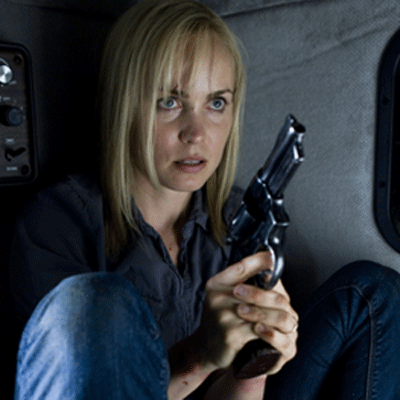
For my essay, I have watched four films.
These films were Halloween, The Crazies,
Sinister and Psycho. Halloween, the 1978 slasher horror is a
film about an escaped mental patient at an asylum who returns to his home town and
kills groups of teenagers on Halloween night, the same night he killed his own
sister fifteen years before. The Crazies
(2010 remake) is set in a small American town where an outbreak of a biological
weapon infects its residents turning them into mindless killers. Sinister, a 2012 psychological horror/
ghost story centres on a writer and his family who live in the house of a
murder scene, only to find out they are being stalked by a maniacal entity
attempting to torment and kill them. Lastly, Alfred Hitchcock’s 1960 movie Psycho takes place at a small motel,
where Janet Leigh’s character Marion is murdered and her lover Sam Loomis (John
Gavin), Sister Lila Crane (Vera Miles) and Detective Arbogast (Martin Balsam) go
off to investigate her disappearance.
All of the above films include the appearance
of a female role; however in each case they are slightly different, ranging
from main characters to supporting roles. In Halloween, Jamie Lee Curtis’s character Laurie is considered a
heroine, a bit boyish and ends up being the character that fights off Michael
Myers and protects the children. In The
Crazies, Radha Mitchell’s character Judy is the pregnant house wife of a
sheriff, and therefore always relies upon him to save her. In Sinister, Tracy (Juliet Rylance) is
shown as someone with very strong opinions on the work her Husband Ellison
(Ethan Hawke) does. She has a large influence on him and shows to be a strong
mother-type figure. Finally in Psycho, Marion
Crane is portrayed as a rebellious character who steals $40,000 from the company
she works at, but ends up getting her comeuppance and gets murdered half way
through the film, even though Hitchcock gives her the most camera time during
the beginning of the film, making the audience assume she would be the heroine
of the film. In the same film, Lila Crane is made out to be a “Damsel in
Distress” character that ends up being saved by Sam.

However, in Psycho, Lila Crane is also depicted as intelligent, due to how she
discovers that Norman is the killer before Sam and the late Detective Arbogast.
Despite her physical weakness (shown when she is attacked by Norman Bates) she
is represented as a heroine. Clover’s “Final Girl” is the name given to a
female role in movies (particularly the slasher genre) that end up being the
heroine or the strongest out of all the other characters. The final girl is
usually virginal, organised or alert (being that she avoids the vices of the other
victims, such as drugs, sex and alcohol), often has a few masculine qualities
about her and ultimately fights back against the killer. For example, Lila
Crane can be described as a final girl as she isn’t known to be in a
relationship and has a sharp intelligence. Another example of a final girl is
Laurie from Halloween, who isn’t in a
sexual relationship or drink alcohol. While her friends are being murdered
because they were off drinking and having sex instead of paying attention to
all the warning signs of Myers’ presence, she keeps keen eyes on him and stayed
alert throughout the film. She ends up fighting off Myers as well as using her
intelligence and wits to keep her and the children safe.

Clover argues that the final girl is the
character that the mostly male audience identify with, not the killer, and that
although they are the victims, they are usually strong willed and determined to
live. Clover suggests there are many reasons for the audience (particularly the
male audience) to affiliate themselves with the final girl rather than the
killer, such as they identify with the fright of being attacked, and that they
see the final girl as someone who remains quite masculine, strong and
independent, but also feminine enough to be sexualised and fantasied by the
male audience.
However, the critic Laura Mulvey believes
that the female characters in movies are the opposite of what Clover believes.
Mulvey believes that women are objectified in movies, made out to be things of
heterosexual male’s pleasure. Female protagonists like Angelina Jolie in Lara Croft: Tomb Raider is considered to
be a step back from earlier heroines (being she is portrayed as a very
sexualised character only there for the male audience to “enjoy”), and Mulvey
believes women are treated like objects in movies. One of the ways this can be
backed up is the POV camera strategy of tilting the camera from the bottom of
the legs to the chest area/ bottom of the head, mimicking the gaze of a
heterosexual male looking up a woman. This can be seen in Halloween, when Myers is peering through the kitchen window of
Annie’s house whilst Annie takes her clothes off as she had spilt butter down
her shirt. The camera takes on a POV approach to the scene, making the audience
see through the eyes of Myers and how he watches Annie get undressed. This can
also be seen in Psycho, where Norman
Bates peers through the hole in the wall watching Marion get ready for her
shower. This helps to prove Mulvey’s theories that women are often objectified
in movies and that they are only included to sexualise the movie and provide
eye candy for the heterosexual males.
These two critics have very different views
on how women are treated in films and the horror genre. On one hand, Clover is
correct saying that there’s often a “final girl,” who is strong and empowered
who ends up defeating or escaping the villain, while Mulvey is also correct
saying that women are often seen “through the eyes of a man.” Clover’s “Final
Girl,” the heroine who is escape or defeat the villain, is often physically
weak, often shown to cower in immediate danger and tends to be attractive,
someone who the male viewers could not only support but feel attracted to. However,
while it is true that women are often shown to be attractive and pretty, they
are also shown to be strong, independent and quick witted in certain
situations, as Clover’s “Final Girl” shows. They are often shown to be more
reliable than males in horrors too, as males tend to be stupid or careless and
end up getting killed relatively quickly. Many other critics also commented on
Mulvey’s beliefs, saying that, if what she said was true, it would be
impossible for females or gay males to enjoy classical Hollywood films, as all
they do is cater for a straight male’s fantasies and desires from women.
In
conclusion, I believe that Carol J. Clover has the strongest argument on
females in the horror genre, as it always seems to be the females who are
strong in the face of danger and end up outsmarting both the villain and the
other male companions. Some examples of the final girl outsmarting or escaping
the villain are Halloween, where
Laurie defeats Myers with the help of Dr Loomis, Friday the 13th, where Alice manages to cut the head off
Mrs Voorhes, Psycho, in which Lila
manages to uncover the secret of Norman Bates and solves the murder case, Texas Chainsaw Massacre, where Sally
escapes Leatherface, and Jennifer’s Body,
where Needy manages to stab Jennifer in the heart.

No comments:
Post a Comment