Friday, 29 March 2013


Psycho trailer
Psycho Trailer.
Other clips also
add to this sense of mystery, including eerie shots of Norman Bate’s (played by
Anthony Perkins) motel and his mother’s house, with other shots of the swamp
where Norman hides the evidence of his killings, showing the victim’s car
sinking into the sludgy waters. It tells the viewer the general setting of the
movie, and an act that seems rather sinister or strange, but never tells the
viewer what’s significant about these places and the scenes being shown. It
gives the viewer enough information to feel the need to continue their pursuit
of unravelling the mystery, but doesn’t give away so much they know how the
film plays out.
I also like how the Trailer shows the supposed roles of
characters, when the roles given to characters in the trailer are not the same
as in the film. Using Vladimir Propp’s theory of Narrative structure on the 8
roles of characters in a fairy story, we can see that Marion is depicted as
being the Heroine of the film (despite the fact that she’s the first murder
victim), by giving her the most camera time in the trailer. This is firstly to
show who we are meant to side with when we go and see the film, but could also
be interpreted as being a red herring. We see she has the most camera time and
automatically assume she will be the heroine who brings the killer to justice,
so when she does get killed, it becomes an even bigger shock to those who’ve
seen the trailer, as they assumed she will be the one to solve the case. In the
actual film, it is more appropriate to label Marion as the princess, due to the
fact that the Detective, her boyfriend and her sister go off looking for her.
During this trailer we also see a lot of Norman Bates, the false hero. We see
many shots of him not only helping the heroes of the film, but also a lot of
shots of him acting suspicious and creepy. We see him accompanying the
detective, Milton Arbogast (played by Martin Balsam), but then more scenes of
him looking out of windows and hilting his head over an unseen object. We can
assume he is hiding something in these scenes but also that he’s trying to
help, even if he’s unsure if he should or not.
The Villain, Norman’s mother
(or, to be precise, the personality of his mother), is not shown in the
trailer, partly because it would spoil the entire plot twist ending to find out
who she really is, but mostly because it adds an aura of mystery to the
supposed killer. We know that she is the most likely suspect, as Norman often
talks about her in the trailer, and quotes “It’s not as if she were a maniac,
she just does a little mad sometimes.” But with only glancing snippets of
footage from the film showing the back of his mother in a chair, attacking
Marion in the shower and her body being carried downstairs by her son, we never
get to see the true face of his mom. The trailer allows us to make up our own
images of what she may look like, which in most cases are likely to be evil or
sinister looking, as well as never giving away her true identity and spoiling
the ending.
We also see a few shots of other characters, such as Det. Arbogast
(the “Helper” role) as he is sent out to find Marion, Lila Crane (the “donor”
role, played by Vera Miles) as she offers herself to help the investigation,
and Sam Loomis (played by John Gavin). Sam can either be described as being the
father figure, as he (and Lila) hired the detective to look for Marion, or the
hero, as he is the overall saviour of Lila and discovers the fate of the
Detective and Marion. However, in the trailer, he is simply depicted as Marion’s
love interest.
As you can see, the trailer shows off the roles of all the
characters in the film so you can understand who we are to direct our attention
to, however it tries to trick the viewer into believing that Marion is the
hero, making it an even bigger shock to viewers when they find out she is the
murder victim. To people who still haven’t seen the film, this will end up
adding a twist of events that will throw them off course with how they
predicted the story will turn out, making them even more scared and keeping the
tension heavy.
Sinister Trailer Analysis
From the Sinister trailer, much like the Psycho trailer, allows the viewer to get
a summary of the plot without spoiling anything major in the storyline. You are
introduced to the main characters, the Oswalt family, Ellison, Tracy, Trevor
and Ashley (Ethan Hawke, Juliet Rylance, Michael Hall D’Abbario and Clare
Foley), who are shown to move into a house 9 months after a murder took place there.
From the scenes shown in the trailer, you get a good sense of Todorov’s equilibrium
and disequilibrium, where in the equilibrium the Oswalt family have moved into
their new house and act the same way as they have so in the past, children are disobedient
and the Ellison is trying extremely hard to write a successful book. However,
this equilibrium is disrupted when Ellison discovers the films and realises how
many people were involved in these deaths. The new equilibrium that is present
in all media texts is obviously not shown; this is a trailer and they want to
entice the viewer to see the film with promising snippets that give away enough
to keep the audience wanting more.
One of the things
that the trailer does well is it gives us an eerie atmosphere, due to the house
chosen for the setting. The house is rather alone in the middle of nowhere, and
the attic in particular is extremely claustrophobic and dark. The lighting as
well is extremely moody and atmospheric, giving the viewer a sense of dread and
fear as the lighting is always quite low key. One more thing that stands out in
the trailer is the music, which is very subtle at the start, then gradually
gets louder. It’s in a minor key, and also sounds very distorted and
electrical, like static. When a jump-scare flashes on screen, the music usually
becomes incredibly distorted and loud, creating a scratching noise that makes us
cringe and jump. These are quite common in a traditional horror film trailer,
and when the viewer sees this, they should become very aware what they are
viewing and (if they are horror fans) draw their attention.
There are many themes in this trailer, most noticeably a
supernatural theme. This theme is very strong throughout the trailer, as you
can see throughout it scenes pictures of pagan rituals, demonic symbols and
blood on the wall. However, the strongest supernatural theme in the film is the
use of the main antagonist, Bughuul (Nicholas King), and the spirits of the
dead children he’s captured. We can see this through the makeup first through
the makeup of both the children and Bughuul, the children being pale and damp
with dark eye sockets and cracking skin, while Bughuul is wearing all black
with white and black makeup that almost resembles war paint. Through second
observation, we see that he has supernatural powers and is a formidable,
intimidating antagonist. We first see his supernatural abilities when Ellison
holds the picture of Bughuul up to the window to align the scenery with his
back garden. When he removes the photo, Bughuul is standing in the same spot he
was standing in the photo, before disappearing again. We see this a second and
third time, secondly when the still picture of him on Ellison’s computer begins
to turn his head and stare at Ellison, and thirdly when Ellison enters the
attic to find the dead children watching the tapes, and Bughuul jumps out of
nowhere in front of the camera. Other themes of supernaturalism can be seen
when Trevor’s body rises up from the cardboard box and screams at the camera,
as well as when one of Ellison’s helpers was describing Bughuul and telling the
audience he’s a pagan god who devours children. The use of this supernatural
element not only tells us what sub genre of horror movie this is (supernatural,
psychological, ect), it also adds a sense of mystery to the trailer and makes
the viewer want to find out what type of supernatural being this antagonist is,
making them want to watch the film and see the mystery unfold.
When discussing themes, we can also relate back to Claude
Levi-Strauss, as his narrative theory on binary opposites relate directly to
opposing themes. There are a few opposing themes we can see in this trailer,
such as safety and danger, night and day and family and murder/ life and death.
With safety and danger and light and dark, they are both heavily linked. The
family and Ellison all seem to be very safe during the day time, Ellison can
concentrate on his family and work and everything seems to be happy or normal.
During the night/ dark, bad things happen, such as Trevor’s body rising from
the box, the appearance of the dead children and the timely appearances of
Bughuul. With family and murder (or life and death) we see a contrast of the
two a lot of the time when watching short snippets of the old film reels. We
first see the old family who lived in the house before the Oswalts, and then we
see them all hanging themselves/ being murdered immediately after. This huge
contrast between the scenes has huge impact on the viewers, who watch the
trailer casually, then snap to attention in fear when the scene of the family
being hung gets thrown onto the screen in a flash.
All of these uses of contrasting themes can be very
effective on the viewers. When watching the trailer, the quick cuts to
seemingly safe, suburban life to horror and death create a feeling of constant unease.
While watching just the safe suburban lifestyle, it will keep the audience continuously
feeling safe no matter how much you try to advertise it to horror fans, while
if keeping it constantly on the horror, the viewer may feel like it’s trying to
be shoved in their faces too much, or may become desensitised to it. With this
montage of scenes, cutting back and forth between safe and unsafe, it keeps the
viewer on edge for what may pop out next.
The Descent Analysis
In the Descent trailer, the audience is
introduced the main characters and the overall plot of the film. Right from the
start of the film, we are introduced to the characters through a scene of them
all posing in front of their log cabin for a photo. We see Sarah (Shauna
McDonald), Juno (Natalie Mendoza) Beth (Alex Reid), Rebecca (Saskia Mulder),
Sam (MyAnna Buring) and Holly (Nora-Jane Noone) all posing outside of their
cabin, which tells the viewer of the trailer who the main protagonists are and
who we’re meant to route for. When looking at characters, we could relate back
to Vladimir Propp’s theory on character roles in narrative structure, however,
due to the nature of the trailer it’s hard to pinpoint character roles. As you
can see, the lighting for the entire trailer has very low key lighting; due to
the fact the setting is an underground cave. However, you can just about make
out that Sarah is supposedly the lead role, or “hero”, as she gets the most
camera time. She is also most likely going to be Clover’s final girl, as she
was the first one to point out in the trailer that she saw something. The
identification with characters and their roles is important in media texts;
however in this trailer they don’t make the roles of the characters very clear.
Due to the nature of the film, being the film is set in a claustrophobic cave,
this may be because they want to add an air of the unknown to the film and make
it even more mysterious. The unknown can be very pressing sometimes when
frightened, and the use of this may help add to the theme of claustrophobia to
the trailer.
As said previously,
the atmosphere is very claustrophobic in the trailer. This is mostly to do with
the fact that near enough the entire trailer takes place in an underground
cavern with very low key lighting, but also because of the music. Much like the
Sinister trailer, the music begins
very quietly at the beginning and then gradually crescendos to a very loud
climax, and the overall music is more of a hum rather than a score with a
noticeable tempo to it. During jump-scares, it very suddenly climaxes so it’s
extremely loud and sharp to the ear, making the viewers jump more. As stated in
the Sinister trailer analysis, this
is all very common to horror fans and these factors will draw their attention.
There are many
iconic images that can be seen here that relate to both horror and cave
exploration. For example, during a montage of clips while quotes from critics
hover on screen, there was a scene when one of the characters rises up from a
pool of blood extremely slowly. This is an iconic image of what we expect from
horror films, something weird and horrifying that we would see in a nightmare,
and is also similar to other horror films scenes where monsters rise up from
the mud of pools of slime. Another scene is a small clip of a knife flashing
through the air, while it makes a swishing, screeching noise. This noise of the
knife coming down and piercing flesh is very iconic as a sound effect used in
other horror movies, such as slashers. When considering cave exploration, you
can see the typical equipment of an explorer or an extreme sportsman would don
being worn by the protagonists, such as utility belts, flashlight hats, flares
and hand picks. This tells us that this horror movie is all about explorers,
and the setting shows them being underground, with the iconic images of stalagmites
and stalactites adorning the cave ceilings and floors, which tell us that this
movie will all be about what these adventurers find down in this cave. All of
these iconic images, settings, items and noises used are here to make the whole
setting and plot more believable, as we all automatically expect cave explorers
to have mountain climbing equipment and exploration gear, as well as try and
entice horror fans to come and see the film.
Halloween and The Crazies
John Carpenter’s 1978 film Halloween and Breck Eisner’s 2010 remake
of The Crazies contains many uses of
the 4 theories of narrative structure.
Tzventan Todorov
Todorov’s theories on narrative
structure suggest that all narratives have 3 stages or “equilibriums.” There is
a state of initial “status quo” equilibrium where life for the characters are
normal/ the forces of good and evil are balanced. This is then disrupted by
some sort of event, usually the case of evil overbalancing the forces of good.
This disequilibrium causes the heroes of the narrative to go and try and
restore the status quo, and at the end of the narrative there is a new
equilibrium. This new equilibrium provides some sort of closure to the story,
and can either be good or bad, depending on the genre of narrative and how the
narrative plays out throughout the entire text.
In Halloween the narrative still follows this path. We have the
initial equilibrium, where Laurie and her friends live happily in their
suburban life, then the event of Michael Myers escaping from the lunatic asylum
through Dr. Loomis’s car causes disequilibrium, after which he then stalks and
murders Laurie’s friends and attempts to murder her. The new equilibrium then
provides a form of closure, showing us that Dr Loomis saves Laurie from Myers
by shooting him off the balcony, only for Myers to escape again. This type of
conclusion adds to the theme of mystery, tension and fear throughout the film,
as Myer’s survival tells the audience that they’re still not safe and Myers
could still be hiding anywhere, waiting to strike.
In The Crazies the initial status quo equilibrium shows that the town
and its inhabitants. They live regular lives in this small place where
everybody knows everybody. Then the status quo is disrupted and a new
equilibrium emerges when the David interrupts the Baseball game by shooting a
local resident, Rory, when he arrives bearing a shotgun, as well as when a
local farmer burns down his own house with his wife and child still inside. Something
is definitely not right with the people of the town, and when the military show
up, David, his Wife Judy and Deputy Russell Clank, discover that the military
accidently unleashed a bio-weapon on the town. The new equilibrium shows us
that David and Judy escape, only for the military to hunt them down and quarantine
the city they are headed to. Much like Halloween,
this leaves the ending open so viewers can wonder what happens next, and
adds a sense of dread as you know that the military will attempt to exterminate
the protagonists and the rest of the city.
Vladimir Propp
Propp’s theories on narrative
structure suggest that in every story there are 8 main roles filled by certain
characters encountered throughout the story. By comparing fairy tale stories,
he has discovered that the 8 main roles of characters in films are:
· *
The Hero.
·
* The
Villain.
·
* The Donor
(the character who provides the hero with a magical or powerful object).
·
* The Helper
(the character who aids the hero).
·
* The Princess (the
reward for the hero, the sought after person and object of the villains schemes).
· * Her Father (the man
to give the reward).
· * The Dispatcher (the
character who sends the hero on the quest).
· * The false hero.
In Halloween, we can label many of the on screen characters with
Propp’s roles. The first two obvious roles are the roles of Laurie (the hero)
and Myers (the villain). In Halloween Laurie
is the hero as she gets the most screen time and she has the most important
role; namely discovering who murdered her friends and to protect the two
children Tommy and Lindsey from Myers. Myers is the villain as he is the one
who causes the disequilibrium by escaping the asylum and hunting down Laurie
and her friends. He also stalks and murders Annie, Bob and Lynda, and attempts
to thwart the hero by murdering her. The helper in the film is Dr Loomis, the
psychiatrist of Myers, who attempts to track down Myers and aids both the
Police and Laurie in finding and stopping him. The false hero can be seen as
being the Sheriff, Annie’s father, as although he wants to help find Myers he
also dismisses Loomis and eagerly tries to force himself into believing Myers
isn’t as much as a threat Loomis makes him out to be. If he had listened to
Loomis then many of the murders throughout the film could have been avoided.
However other roles such as the
donor, father and dispatcher are seemingly lacking in the film. The 3 other
teens, Annie, Lynda and Bob can be referred to as they are the objects of the
villains schemes (being to murder teens), as well as being sought after by
Laurie after Lynda’s disturbing phone call as she was being strangled by Myers.
Yet the other roles are unfulfilled, which maybe because of the nature of the
slasher/ horror genre of because there was no need of those roles in this
particular narrative text.
In The Crazies, the main role of Hero is given to David, as he is the
character with the most screen time and the character who’s given role of
protecting his wife and escaping the town. In the film there is no obvious villain,
only the townsfolk infected by the virus and the military, with no single
figure that stands out as a leader or villain. There is no obvious Donor
either, however the driver of the government SUV who Russell interrogates and
kills could possibly be one, as it was through him that the protagonists
discover about the virus and how the military accidently unleashed it. The
Helper is Russell, David’s deputy and best friend. Russell is noticeably
infected with the virus half way through the film, and when he himself realises
this he offers to sacrifice himself so that David and Judy have a chance of
surviving. Judy, David’s wife, can be labelled as the Princess, as she’s the
character that David strives to save. He escapes the military camp especially
to find her, and he is always the first to try and save her when she’s in
danger. She is also pregnant, which makes her extremely vulnerable and
(seemingly) the target of many of the infected civilians. The Father and the
dispatcher roles do not seem to be present in any of the characters, as Judy
(the princess) is independent from all of the characters aside from David, who
is the hero, making Judy his princess or “reward,” and the group of survivors are
not given their quest by a dispatcher, as they figure out their plan of action
by themselves. The False Hero can be seen as being Mayor Hobbs, as he refuses
to help David by not shutting off the water supply for the town and crops, as
the virus is spread through the water. If it wasn’t for him a lot less people
wouldn’t have been infected.
Claude Levi-Strauss
Levi-Strauss’ theory on
narrative structure suggests that narrative texts contain many binary opposites.
An example of this would be good and evil, as both are the direct opposite of
each other. These binary oppositions help us to understand deeper themes of the
media text.
In Halloween, we can put use Levi-Strauss’ theory to help understand
the deeper arrangements and meaning of themes in the film. Firstly, one of the
first binary opposites present in the media text is Sanity and Insanity.
Sanity, held by Dr Loomis and Laurie, shows strength and determination during
the periods of fear when Myers attacks them, while insanity, held by Myers,
shows how cold he is and how he has no regard for life, killing when and where
he likes with no emotion. This can also be linked with Courage and fear, Laurie
and her friends being fearful of Myers while Loomis acts with courage against
him. An obvious binary opposite is good and evil, Laurie representing good as
she babysits the kids, while Myers is evil, as he murders the teens. Laurie
could also be represented as good by the fact that she is a virgin, being that
the other teens had all had sex (either on-screen or having it referred to off
screen) and had ended up being killed by Myers. As Laurie is a very virginal
character who doesn’t drink, smoke, have sex or gets into mischief with her
friends she ends up being the hero who helps defeat Myers (this character
profile or role is known as the “Final Girl” in horror/ slasher movies). More
themes include safety and danger, safety referring to the suburban
neighbourhood and danger referring to Myer’s old house. The American suburban
town is very often seen as a safe, secure area to bring up children and to
settle down, and isn’t often seen as a dangerous area, while Myer’s house is
dangerous as it’s dilapidated and weatherworn as it’s old and abandoned. This
binary opposite also heavily linked to Day and Night, or Light and Dark. During
the day or when the lights are on in the house, the characters are safe from
Myers as he only seems to observe them at most, while during the night or when
the house is dark, Myers attempts to make his moves to kill the teens and
succeeds in murdering 3 teens during the cover of darkness.
In The Crazies, there are many themes that can also be seen in Halloween, such as insanity and sanity,
courage and fear, good and evil and safety and danger. Insanity is held by the
infected, as they kill for no good reason and without an emotional response to
what they’ve done due to the virus, while the survivors are sane and try to act
rationally to their situation and attempt to escape the town without becoming
infected themselves. With fear and courage, the girl Becca can be used to
represent fear, as well as many other of the unnamed civilians seen throughout the
town, as she is extremely frightful for her life and needs David and Judy to
help her through the difficult times surviving the military and the infected,
while courage is held by Judy, David and Russell as they have to stay strong to
survive. Courage can be seen particularly in Russell, as he knows he is
infected and offers to sacrifice himself so David and Judy have a chance of
escaping. With the two binary opposites good and evil, we can see that the
survivors represent good, the few who aren’t infected fighting against the
impossible forces of the infected and the military combined, while the infected
and military are represented as evil; the infected as they are insane and
extremely hostile, the military for attempting to exterminate the townsfolk.
Another thing in the crazies that could represent good is the town itself. The
town is the model of a small, American farming community where everyone is
friends with everyone and people feel safe. When the military bring their
bio-weapon virus down upon them, the townsfolk are no longer represented as “good”
as they have been infected. This relates to safety and danger, as the whole
town can be seen as a safe haven; small, tight-knit and friendly. However, the
military camps or deserted farm land can be seen as dangerous, the camps are
they are heavily controlled by the military to help exterminate the townsfolk
and infected, making them dangerous, as well as the open farm land as there is
no shelter from the military helicopters or infected. As well as all that has
been mentioned in Halloween, there
are other themes that can be seen in The
Crazies. Love and hate, which related closely to sanity and insanity, is
present throughout the whole film. Love can be seen between David and Judy,
they both love each other to the point that they would die for one another, and
the presence of Judy’s unborn child helps strengthen this love. Love (or
friendship) can also be seen between David and Russell, as they are extremely
close friends and companions. However, hate can also be seen between David and
Russell once Russell gets infected. He becomes extremely aggravated by what the
survivors do, and what threatens to kill David and Judy at one point. Although
this hatred is forced onto Russell due to the virus, it’s very obviously there
throughout the middle sections of the film. Hate can also be seen throughout
the infected town folk, where the unnamed farmer burnt his house down with his
wife and child, and where the coroner attacked David with the saw.
Bordwell and Thompson
Bordwell and Thompson’s theory
on narrative structure defines a narrative as “a chain of events in a
cause-and-effect relationship, occurring in time and space.” While we view the important scenes of the
narrative onscreen during the movie, there are many events that are directly
linked to the story but happened off screen.
In Halloween, there is an example of this when Dr Loomis describes to
the sheriff about how he studied Myers, saying “I watched him for fifteen
years, sitting in a room, staring at a wall, not seeing the wall, looking past
the wall, looking at this night, inhumanly patient, waiting for some secret,
silent alarm to trigger him off.” Loomis talks about something story important
which isn’t shown during the film. This is because it’s an extremely long event
that takes 15 years to tell, and it would take too long to show in film.
Another example is when Loomis is tracking Myers and he tracks him to a gas
station, and you see the corpse of the truck driver. The murder was not seen,
but due to the editing and linking Loomis tracking Myer, we assume that Myers
killed the trucker. This is important for Halloween
as it allows us to see the main points of the film (mainly Myers killing
teenagers) while also being informed of other critical plot points in quick
explanations. It also allows us to use our minds to link up evidence and keeps
the viewer guessing and looking out for clues.
In The Crazies, there is an example of this in the very first scene,
where you see the town of Ogden Marsh on fire. There are no civilians in sight,
and cars are lit on fire whilst the town’s banner falls to the floor in a
burning fireball. In then cuts to black and on screen text comes up saying “Two
Days Earlier.” This is used to show us that in the near future something
terrible will happen to the small town, which is used to help pull in the
viewers and get them engrossed in the film. Another example of this theory is
when David and Russell are investigating the dead pilot out in the marsh and
start looking for the plane. Russell says “last week Travis Clune was goin’
around sayin’ he heard somethin’ crash out by hopnin’ bog.” We do not see the
crash, but using our imagination we can gather that the death of the pilot and
the sound of something crashing are link and make a mental connection that the
dead pilot was piloting whatever it was that crashed.
Conclusion
The most important theorist on
narrative structures would most likely be Levi-Strauss, as his theory allows us
to delve deeper into the themes of Halloween
and The Crazies, helping the director
create meaningful sets and characters which fit in with the slasher genre.
Levi-Strauss and Binary Opposites allowed us to see two opposing themes in
narratives, which can be used to cause conflict and drama in the plot.
The Representation of Women in Horror films
In horror films, women are often important to
the overall plot and have key roles in the film. In the slasher genre many
people think women are often depicted as being the victims of murder and
torture, the characters the murderers are out to get. However are women roles
in horrors simply for heterosexual males to objectify or are their roles more
subtle and used to redefine what it is to be a heroine?


In this essay I will be exploring the roles
of female characters in the Horror genre. I will be looking at the two
theorists, Laura Mulvey and Carol J. Clover, who both have their own opinions
on a woman’s role in horror films. By examining the four films Halloween, The Crazies (2010), Sinister and
Psycho, I will decide on which
theorist I agree with the most on their opinions on a female’s role in Horrors.
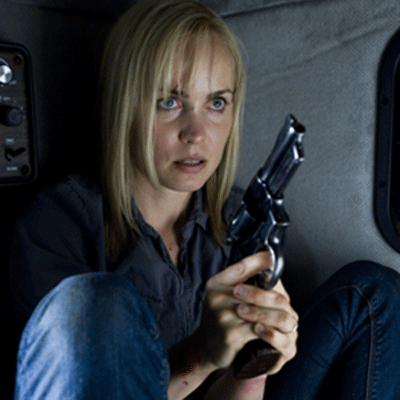
For my essay, I have watched four films.
These films were Halloween, The Crazies,
Sinister and Psycho. Halloween, the 1978 slasher horror is a
film about an escaped mental patient at an asylum who returns to his home town and
kills groups of teenagers on Halloween night, the same night he killed his own
sister fifteen years before. The Crazies
(2010 remake) is set in a small American town where an outbreak of a biological
weapon infects its residents turning them into mindless killers. Sinister, a 2012 psychological horror/
ghost story centres on a writer and his family who live in the house of a
murder scene, only to find out they are being stalked by a maniacal entity
attempting to torment and kill them. Lastly, Alfred Hitchcock’s 1960 movie Psycho takes place at a small motel,
where Janet Leigh’s character Marion is murdered and her lover Sam Loomis (John
Gavin), Sister Lila Crane (Vera Miles) and Detective Arbogast (Martin Balsam) go
off to investigate her disappearance.
All of the above films include the appearance
of a female role; however in each case they are slightly different, ranging
from main characters to supporting roles. In Halloween, Jamie Lee Curtis’s character Laurie is considered a
heroine, a bit boyish and ends up being the character that fights off Michael
Myers and protects the children. In The
Crazies, Radha Mitchell’s character Judy is the pregnant house wife of a
sheriff, and therefore always relies upon him to save her. In Sinister, Tracy (Juliet Rylance) is
shown as someone with very strong opinions on the work her Husband Ellison
(Ethan Hawke) does. She has a large influence on him and shows to be a strong
mother-type figure. Finally in Psycho, Marion
Crane is portrayed as a rebellious character who steals $40,000 from the company
she works at, but ends up getting her comeuppance and gets murdered half way
through the film, even though Hitchcock gives her the most camera time during
the beginning of the film, making the audience assume she would be the heroine
of the film. In the same film, Lila Crane is made out to be a “Damsel in
Distress” character that ends up being saved by Sam.

However, in Psycho, Lila Crane is also depicted as intelligent, due to how she
discovers that Norman is the killer before Sam and the late Detective Arbogast.
Despite her physical weakness (shown when she is attacked by Norman Bates) she
is represented as a heroine. Clover’s “Final Girl” is the name given to a
female role in movies (particularly the slasher genre) that end up being the
heroine or the strongest out of all the other characters. The final girl is
usually virginal, organised or alert (being that she avoids the vices of the other
victims, such as drugs, sex and alcohol), often has a few masculine qualities
about her and ultimately fights back against the killer. For example, Lila
Crane can be described as a final girl as she isn’t known to be in a
relationship and has a sharp intelligence. Another example of a final girl is
Laurie from Halloween, who isn’t in a
sexual relationship or drink alcohol. While her friends are being murdered
because they were off drinking and having sex instead of paying attention to
all the warning signs of Myers’ presence, she keeps keen eyes on him and stayed
alert throughout the film. She ends up fighting off Myers as well as using her
intelligence and wits to keep her and the children safe.

Clover argues that the final girl is the
character that the mostly male audience identify with, not the killer, and that
although they are the victims, they are usually strong willed and determined to
live. Clover suggests there are many reasons for the audience (particularly the
male audience) to affiliate themselves with the final girl rather than the
killer, such as they identify with the fright of being attacked, and that they
see the final girl as someone who remains quite masculine, strong and
independent, but also feminine enough to be sexualised and fantasied by the
male audience.
However, the critic Laura Mulvey believes
that the female characters in movies are the opposite of what Clover believes.
Mulvey believes that women are objectified in movies, made out to be things of
heterosexual male’s pleasure. Female protagonists like Angelina Jolie in Lara Croft: Tomb Raider is considered to
be a step back from earlier heroines (being she is portrayed as a very
sexualised character only there for the male audience to “enjoy”), and Mulvey
believes women are treated like objects in movies. One of the ways this can be
backed up is the POV camera strategy of tilting the camera from the bottom of
the legs to the chest area/ bottom of the head, mimicking the gaze of a
heterosexual male looking up a woman. This can be seen in Halloween, when Myers is peering through the kitchen window of
Annie’s house whilst Annie takes her clothes off as she had spilt butter down
her shirt. The camera takes on a POV approach to the scene, making the audience
see through the eyes of Myers and how he watches Annie get undressed. This can
also be seen in Psycho, where Norman
Bates peers through the hole in the wall watching Marion get ready for her
shower. This helps to prove Mulvey’s theories that women are often objectified
in movies and that they are only included to sexualise the movie and provide
eye candy for the heterosexual males.
These two critics have very different views
on how women are treated in films and the horror genre. On one hand, Clover is
correct saying that there’s often a “final girl,” who is strong and empowered
who ends up defeating or escaping the villain, while Mulvey is also correct
saying that women are often seen “through the eyes of a man.” Clover’s “Final
Girl,” the heroine who is escape or defeat the villain, is often physically
weak, often shown to cower in immediate danger and tends to be attractive,
someone who the male viewers could not only support but feel attracted to. However,
while it is true that women are often shown to be attractive and pretty, they
are also shown to be strong, independent and quick witted in certain
situations, as Clover’s “Final Girl” shows. They are often shown to be more
reliable than males in horrors too, as males tend to be stupid or careless and
end up getting killed relatively quickly. Many other critics also commented on
Mulvey’s beliefs, saying that, if what she said was true, it would be
impossible for females or gay males to enjoy classical Hollywood films, as all
they do is cater for a straight male’s fantasies and desires from women.
In
conclusion, I believe that Carol J. Clover has the strongest argument on
females in the horror genre, as it always seems to be the females who are
strong in the face of danger and end up outsmarting both the villain and the
other male companions. Some examples of the final girl outsmarting or escaping
the villain are Halloween, where
Laurie defeats Myers with the help of Dr Loomis, Friday the 13th, where Alice manages to cut the head off
Mrs Voorhes, Psycho, in which Lila
manages to uncover the secret of Norman Bates and solves the murder case, Texas Chainsaw Massacre, where Sally
escapes Leatherface, and Jennifer’s Body,
where Needy manages to stab Jennifer in the heart.
Subscribe to:
Comments (Atom)